When water invades your home – whether from a burst pipe, a washing machine overflow, or a flash flood – the terminology can get confusing fast. You’ll hear contractors and restoration companies use terms like “flood cleanup” and “water damage restoration” almost interchangeably. But are they actually the same thing? The short answer is no. While both involve removing water and repairing your property, they are distinct processes with different scopes, timelines, and techniques.
Understanding the difference matters because it affects how quickly you act, who you call, and what your insurance covers. Let’s break it down clearly.
What Is Flood Cleanup?
Flood cleanup refers specifically to the immediate response after a large-scale flooding event. This is typically triggered by external forces – heavy rainfall, storm surges, overflowing rivers, or municipal drainage failures. The water involved is usually classified as “Category 3” or black water, meaning it’s highly contaminated with sewage, debris, chemicals, and bacteria.
The primary goal of flood cleanup is emergency containment and removal. Technicians focus on:
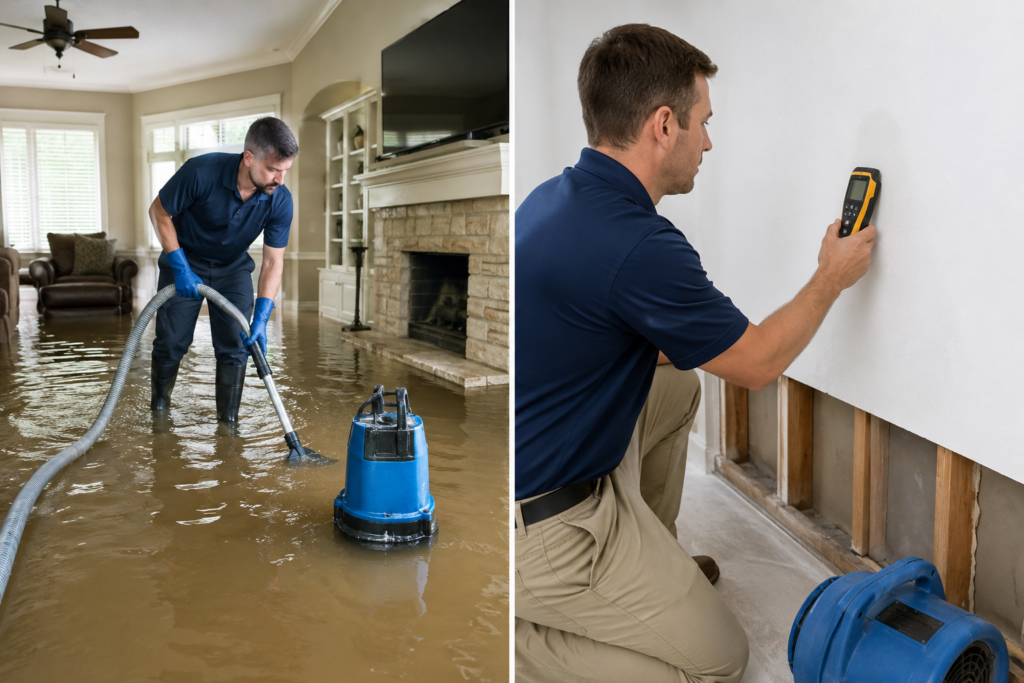
- Pumping out standing water using industrial-grade equipment
- Removing mud, debris, and contaminated materials
- Disposing of unsalvageable belongings and structural components
- Applying antimicrobial treatments to prevent biological hazards
- Initial drying to stop the spread of damage
Flood cleanup is urgent, large-scale, and often involves coordination with city authorities or insurance adjusters. Speed is critical – the longer floodwater sits, the greater the structural damage and the higher the risk of mold growth within 24 to 48 hours.
Our Flood Cleanup Assistance service in Dallas is designed specifically for these large-scale emergencies, deploying rapidly to extract water and secure your home before conditions worsen.
What Is Water Damage Restoration?
Water damage restoration is a broader, more comprehensive process. It encompasses everything from the initial emergency response all the way through to full structural repair and rebuilding. While flood cleanup is one component, water damage restoration covers a much wider range of causes, including:
- Burst or leaking pipes
- Appliance overflows (washing machines, dishwashers, refrigerators)
- Roof leaks
- HVAC condensate line failures
- Toilet and sink overflows
- Sewage backups
The restoration process follows a structured, multi-phase approach:
Phase 1 — Emergency Water Extraction: Immediate removal of standing water using truck-mounted extractors and submersible pumps. Our Emergency Water Extraction team in Dallas responds 24/7 to stop damage at the source.
Phase 2 — Structural Drying & Dehumidification: After visible water is removed, hidden moisture remains inside walls, under floors, and within insulation. Industrial air movers and dehumidifiers are deployed for days to fully dry the structure. Our Structural Drying & Dehumidification service uses moisture mapping to confirm every affected cavity is thoroughly dried.
Phase 3 — Moisture Detection & Monitoring: Advanced tools like thermal imaging cameras and moisture meters are used to locate pockets of hidden water. Skipping this step is one of the leading causes of mold outbreaks weeks after a water event.
Phase 4 — Mold Inspection & Remediation: If mold is detected — or if conditions are favorable for growth — remediation begins immediately. Our Mold Inspection Testing service identifies mold species and extent before remediation begins.
Phase 5 — Structural Repair & Rebuild: Damaged drywall, flooring, insulation, and structural components are repaired or replaced. This phase restores the property to its pre-damage condition.
Key Differences at a Glance
| Factor | Flood Cleanup | Water Damage Restoration |
|---|---|---|
| Cause | External flooding events | Any water intrusion source |
| Water Type | Typically black/gray water | All categories (clean to contaminated) |
| Scope | Emergency removal & containment | End-to-end: extraction to full rebuild |
| Timeline | Hours to days | Days to weeks |
| Insurance | Flood insurance required | Homeowner’s policy often covers |
| Urgency | Extreme (immediate) | High (within hours) |
Does Location Change the Type of Response Needed?
Absolutely. Geography plays a major role in the type of water damage homeowners face and the urgency of the response needed.
In Dallas, TX, where our team operates, homeowners deal primarily with burst pipes from sudden temperature drops, HVAC overflow issues during brutal summers, and storm-related flooding in low-lying neighborhoods like Garland and Arlington. These events often require a blend of flood cleanup and full restoration depending on severity.
In coastal and storm-prone regions of Florida, the situation is even more intense. Cities like Port St. Lucie face hurricane-driven flooding, tropical storm surges, and year-round humidity that accelerates mold growth after any water intrusion. Homeowners in these areas typically need both immediate flood cleanup and comprehensive water damage restoration services working in tandem. If you’re in the Port St. Lucie area, trusted local specialists like Port St. Lucie Water Damage Pros offer exactly this kind of full-spectrum, 24/7 emergency response tailored to Florida’s unique climate and weather patterns.
Understanding your region’s risk profile helps you prepare the right response plan before disaster strikes.
Common Mistakes Homeowners Make
1. Treating flood cleanup as “done” after water removal Many homeowners assume that once the visible water is gone, the job is finished. In reality, moisture embedded in subfloors, wall cavities, and insulation continues to cause damage and fuel mold growth for weeks. True restoration requires thorough drying and inspection – not just extraction.
2. Waiting too long to call professionals Every hour counts. Water migrates quickly through porous materials, and mold colonies can establish within 24 to 48 hours. Our 24-Hour Emergency Response service exists precisely because delayed action almost always leads to significantly higher repair costs.
3. Assuming homeowner’s insurance covers floods Standard homeowner’s insurance typically covers sudden and accidental water damage – like a burst pipe – but does NOT cover flooding from external sources. Flood damage requires a separate flood insurance policy. This distinction directly affects which restoration services are billable to your insurer.
4. Ignoring flooded basements Basement flooding is one of the most underestimated water damage scenarios. Homeowners often delay because the space “isn’t used much,” but a wet basement creates a perfect environment for structural rot and black mold. Our Flooded Basement Cleanup service addresses both immediate extraction and the long-term drying needed to protect your foundation.
When Do You Need Both Services?
In many real-world scenarios, flood cleanup and water damage restoration are not separate events — they’re sequential phases of the same job. For example:
- A hurricane pushes several inches of water into your home. Flood cleanup handles the emergency extraction and decontamination. Water damage restoration then takes over to dry the structure, test for mold, repair drywall, replace flooring, and restore the home to pre-damage condition.
- A burst pipe floods two rooms overnight. The initial emergency water extraction is the cleanup phase. The full restoration involves drying, mold prevention, replacing soaked insulation, and repairing the damaged walls and floors.
The key is hiring a company that handles both – so there’s no gap in service, no miscommunication between contractors, and no delay in moving from one phase to the next.
What to Ask Your Restoration Contractor
Before hiring anyone, ask these questions:
- Are you IICRC-certified for water damage restoration?
- Do you handle both emergency flood cleanup AND full structural restoration?
- Do you use moisture meters and thermal imaging to verify complete drying?
- Will you work directly with my insurance company?
- Do you offer 24/7 emergency response?
A reputable company should answer yes to all of the above.
Final Thoughts
Flood cleanup and water damage restoration are related but distinct services. Flood cleanup is the emergency first response – fast, aggressive, and focused on containment. Water damage restoration is the complete process of returning your home to safe, livable, pre-damage condition.
Knowing the difference helps you ask the right questions, understand your insurance coverage, and make faster, better decisions when water damage strikes. Whether you’re in Dallas dealing with a burst pipe or in a coastal Florida city bracing for storm season, the most important step is always the same: call a certified professional immediately and don’t wait.
The longer water sits, the worse – and more expensive – the damage becomes. Call now (214) 894-2595 for immediate help.
Leave a Reply